
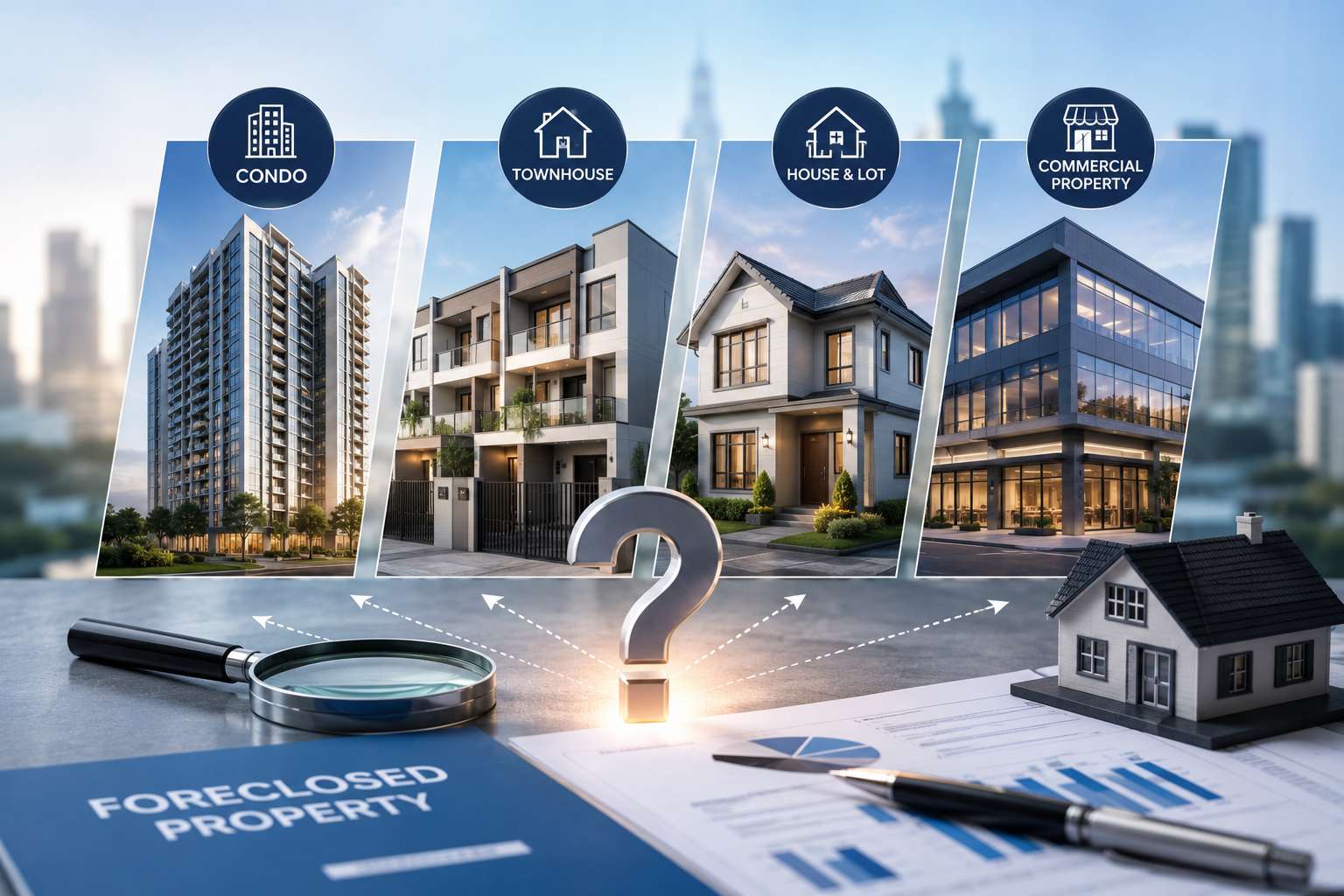

When you are planning to purchase a foreclosed property in the Philippines, one of the most critical decisions you will face is choosing the right property type: condo, townhouse, house and lot, or commercial property. As a broker who has personally guided clients through bank foreclosures and as someone who understands how banks evaluate and dispose of acquired assets I can tell you that the “best” property is not the cheapest one, but the one that aligns with your purpose, financial capacity, and long-term strategy. Let’s walk through each option in a way that helps you clearly identify where you fit.
Understanding Your Options: Which Foreclosed Property Type Fits You Best?
1. Condominium Units (Best for Accessibility & Rental Income)
When you look closely at the Philippine real estate market especially bank foreclosed properties, you’ll notice that condominium units consistently stand out as the most practical and strategic choice for certain buyer profiles. This isn’t just a trend; it’s based on how location, affordability, rental demand, and ease of ownership all come together in one property type.
Why Condo Units Are Ideal for Specific Buyer Profiles
(A) Young Professionals and First-Time Buyers
If you are just starting your career or buying your first property, a foreclosed property type condo unit often gives you the lowest barrier to entry into real estate ownership.
Why this works for you:
- Lower upfront cost
Compared to townhouses or house and lot, condos especially foreclosed ones, are typically priced more affordably. This means lower downpayment and smaller loan exposure, which is crucial if you are still building your income stability.
- Strategic location (near workplaces)
Most condos are located in CBDs like Makati, BGC, Ortigas, or Quezon City, reducing your daily commute. This translates to time savings, lower transportation costs, and better work-life balance.
- Bank financing is more accessible
Banks are generally more comfortable financing condos because they are easier to appraise and resell, especially in prime locations.
- Low maintenance lifestyle
You don’t need to worry about roofing, plumbing systems, or exterior repairs. These are handled by the condo corporation, making it ideal if you have a busy schedule.
Bottom line: A condo allows you to own property early without overwhelming financial and maintenance responsibilities.
(B) OFWs Looking for Passive Income
For many OFWs, the goal is clear: “…build a property portfolio that generates income while they are abroad.”
Why condos are a strong fit:
- High rental demand in urban areas
Condos near offices, schools, and transport hubs are always in demand. This creates a steady pool of tenants, from professionals to students.
- Turnkey investment
Many foreclosed property type condos require minimal renovation compared to houses. You can rent them out faster, which is critical when you’re managing remotely.
- Easier property management
With in-house security and administration, condos are easier to monitor even if you’re overseas. Some buildings even allow property management services.
- Flexible rental strategies
You can choose between:- Long-term lease (stable monthly income)
- Short-term rentals (higher yield, but more active management)
Condos provide predictable income, easier management, and faster deployment of capital, which suits OFWs perfectly.
(C) Investors Targeting Rental Yield (Airbnb or Long-Term Lease)
If your primary goal is cash flow, condos are often the most efficient vehicle especially in high-demand locations.
Why investors prefer condos:
- Strong rental yield potential
In key cities, condos can generate higher rental returns relative to their purchase price, especially when acquired as foreclosed assets below market value.
- Liquidity and resale advantage
Condos are easier to sell or flip, particularly studio and 1-bedroom units, because they appeal to a broader market.
- High occupancy rates
Demand is driven by:- Employees working in CBDs
- Expats
- Students
- Short-term travelers
- Scalability
Investors can acquire multiple condo units across different locations instead of tying up capital in one expensive house and lot.
Condos allow investors to maximize rental income, diversify holdings, and maintain liquidity.
(D) Students or Small Households
For smaller households, the priority is usually practicality, safety, and proximity to daily needs.
Why condos are ideal:
- Proximity to schools and essentials
Many condos are located near universities, review centers, malls, and hospitals, making daily life more convenient.
- Security and controlled access
Condos offer 24/7 security, CCTV systems, and controlled entry points, which is especially important for students living independently.
- Right-sized living space
A studio or 1-bedroom unit is often more than enough, avoiding unnecessary costs associated with larger properties.
- Lower utility and upkeep costs
Smaller space means lower electricity, water, and maintenance expenses.
Condos offer safe, efficient, and convenient living tailored to smaller households.
The Real Reason Condos Stand Out in Foreclosed Property Markets
Across all these profiles, the common thread is this:
- Affordability + Location + Demand = Practical Investment
Foreclosed condos amplify this advantage because:
- They are often sold below market value
- Banks are motivated to dispose of inventory quickly
- Buyers gain instant equity upon purchase (if priced correctly)
Key strengths:
- Lower acquisition cost compared to houses in the same area
- High rental demand, especially in Metro Manila and key cities
- Managed maintenance (handled by condo corporation)
- Access to amenities (security, elevators, gyms)
Watch out for:
- Association dues (ongoing monthly expense)
- Limited space and no land ownership
- Possible occupancy issues or unpaid dues
- Restrictions on renovation and usage
2. Townhouses (Best for Balanced Living & Affordability)
When I recommend a foreclosed property type townhouse to clients, it’s never random, it’s because in actual practice, this property type consistently solves the most common pain points of specific buyer groups. Compared to condos and house-and-lot properties, townhouses sit right in the “sweet spot” of affordability, space, and livability, which is why they naturally fit certain profiles better.
Why Townhouses Are Ideal for Specific Buyer Profiles
(A) Starting or Growing Families
For families who are just beginning or expanding, space and functionality quickly become non-negotiable. A townhouse offers a practical upgrade from a condo without the financial burden of a detached home.
Why it works:
- More usable space across multiple floors – You typically get 2–3 bedrooms, separate living and dining areas, and sometimes a service area. This is critical when children enter the picture.
- Defined privacy zones – Parents and kids can have separate rooms, which is not always possible in smaller condo units.
- Room for future adjustments – You can convert spaces into a home office, study area, or additional bedroom as your needs evolve.
- Safer environment for children – Most townhouses are inside gated subdivisions, allowing kids to play in a more controlled setting.
The biggest issue for growing families is outgrowing their space too quickly. A townhouse delays that problem significantly while keeping monthly costs manageable.
(B) Employees Upgrading from Renting
This is one of the most common client profiles I encounter. Many salaried employees reach a point where renting feels like “dead money,” and they want to build equity.
Why it works:
- Monthly amortization can be comparable to rent – Especially for foreclosed townhouses acquired below market value.
- Better lifestyle upgrade – From a small rented unit, you move into a multi-level home with more privacy and ownership benefits.
- Predictable long-term cost – Unlike rent, which increases over time, your loan amortization is structured and fixed (depending on your loan terms).
- Sense of ownership and stability – This is often underestimated, but psychologically and financially, it’s a major shift.
The transition challenge is usually “I want to own, but I can’t afford a house and lot yet.” A townhouse becomes the most realistic stepping stone.
(C) Budget-Conscious Buyers Needing More Space
Some buyers are very price-sensitive but still need a functional home not just a place to sleep.
Why it works:
- Lower price than detached houses – This is the biggest advantage. You get more square footage without the premium cost of land exclusivity.
- Better value per square meter – Compared to condos, townhouses often provide more livable space for the same or slightly higher price.
- Foreclosed pricing advantage – Banks often dispose of townhouse units at discounted rates, making them even more accessible.
- Reduced compromise – Instead of choosing between “affordable but small” (condo) and “spacious but expensive” (house and lot), you get a balanced option.
The common dilemma here is “I can only afford this much, but I need space for my lifestyle.” Townhouses bridge that gap effectively.
(D) End-Users Who Want a Community Setting
Not all buyers are purely focused on the structure itself, many prioritize the environment they will live in.
Why it works:
- Located in subdivisions or planned communities – This often includes security, controlled access, and neighborhood organization.
- Sense of belonging – You are part of a community, not just a building (like a condo) or an isolated property.
- Access to shared amenities (in some developments): parks, basketball courts, open spaces
- Balanced social interaction – You have neighbors nearby, but still maintain your own private living space.
Some buyers feel that condos are too dense and impersonal, while house-and-lot properties can feel too isolated. A townhouse offers a middle ground, community without overcrowding.
The Deeper Advantage: Why Townhouses Are a Strategic Choice
If you look beyond surface-level features, the real strength of a townhouse lies in its positioning:
- Financially, it’s an entry point to landed living without the full cost of a detached home
- Functionally, it provides enough space for real-life needs, not just basic accommodation
- Strategically, it allows buyers to upgrade later (many clients eventually move to a house and lot after building equity)
In many cases, I advise clients to think of a townhouse as a “transition asset”, a property that improves your quality of life today while positioning you for bigger investments tomorrow.
Important Reality Check (What You Should Still Evaluate)
Even if a townhouse fits your profile, always assess:
- Cut or floor area vs. your actual needs
- Location and accessibility to work, schools, and transport
- Flood risk and neighborhood development
- Association dues and subdivision rules
- Condition of the foreclosed unit (repairs needed)
Remember, not all townhouses are equal, the specific property still matters more than the category.
3. House and Lot (Best for Long-Term Ownership & Flexibility)
When clients ask me why a house and lot consistently stands out among foreclosed property type options, especially for certain buyer profiles, my answer is always grounded in both experience and long-term market behavior: land ownership changes everything. Unlike condos or townhouses, a house and lot gives you control, flexibility, and appreciation potential, three factors that become more valuable the longer you own the property. Let’s go deeper into why this property type is especially ideal for specific buyers.
(A) Growing Families Planning Long-Term Settlement
For families thinking beyond the next 3–5 years, a house and lot is not just a home, it’s a long-term foundation. As your family grows, so do your space requirements. Children need their own rooms, you may need a home office, and eventually, even parking and storage become important.
Why this works best for you:
- Expandable living space – You have the option to renovate, add rooms, or even build vertically as your needs evolve. This is something you simply cannot do in a condo, and only very limitedly in a townhouse.
- Stability and permanence – A house and lot supports the idea of “settling down.” You’re not just occupying a unit—you’re building a home that can last for generations.
- Family-oriented environment – Most house and lot developments are located in subdivisions that are more conducive to raising children—quieter streets, open spaces, and a stronger sense of community.
Key insight: If you’re planning to stay in one place for the long term, constantly upgrading from one property to another can be costly. A house and lot allows you to grow into your home instead of outgrowing it.
(B) Buyers Prioritizing Privacy and Space
If privacy is high on your priority list, then a house and lot is in a completely different league compared to condos and townhouses.
Why this works best for you:
- No shared walls – Unlike townhouses and condos, you don’t deal with noise from adjacent units. This is a major lifestyle upgrade that many buyers only fully appreciate after experiencing it.
- Own outdoor space – Whether it’s a garden, a small yard, or a patio, having your own outdoor area significantly improves quality of life.
- Freedom in design and usage – You can customize your home according to your preferences—whether that’s extending your kitchen, building a home office, or even adding a rental unit.
Key insight: Privacy is not just a luxury, it directly affects your comfort, mental well-being, and lifestyle quality. A house and lot gives you control over your environment, which is difficult to quantify but highly valuable.
(C) Retirees Seeking Peaceful Living
For retirees, the goal shifts from growth to comfort, security, and peace of mind. This is where a house and lot becomes particularly attractive.
Why this works best for you:
- Quiet and less congested surroundings – Most house and lot properties, especially foreclosed ones from banks, are located in suburban or residential areas away from the noise of city centers.
- No dependency on building systems – Unlike condos, you are not reliant on elevators, shared facilities, or property management. This reduces long-term risks and recurring costs.
- Space for personal lifestyle – Gardening, hosting family gatherings, or simply enjoying a slower pace of life is much more feasible.
Important consideration:
While a house and lot is ideal, retirees should also evaluate accessibility (e.g., fewer stairs, proximity to hospitals, and essential services). Not all houses are retirement-friendly without minor modifications. A house and lot supports a self-paced, independent lifestyle, which is exactly what most retirees are looking for.
(D) Investors Focused on Land Appreciation
From an investment standpoint, this is where a house and lot becomes extremely powerful. The truth is simple: Structures depreciate over time, but land generally appreciates especially in developing areas.
Why this works best for you:
- Land value growth – In the Philippines, urban expansion and infrastructure development (roads, transport systems, commercial hubs) consistently drive land prices upward.
- Multiple exit strategies – You can:
- Sell the property as-is at a higher value
- Renovate and flip for profit
- Lease the property for recurring income
- Redevelop into apartments or townhouses
- Scarcity factor – Land is finite. As cities become more crowded, the availability of titled residential lots becomes more limited, increasing their value over time.
Risk consideration: Not all locations appreciate equally. Investors must evaluate future development plans, accessibility, and surrounding infrastructure before purchasing.
Key insight: When you buy a house and lot especially a foreclosed one at below-market value, you are not just buying a home. You are securing a tangible, appreciating asset with long-term wealth potential.
Why House & Lot Stands the Test of Time
Across all these profiles, one common thread stands out:
A house and lot adapts to your life stage, whether you are building a family, seeking privacy, retiring, or growing your wealth.
Yes, it often requires a higher upfront cost and more responsibility, especially with foreclosed property type that may need repairs. But in exchange, you gain something far more valuable:
- Control over your property
- Freedom to grow and modify
- Ownership of land that appreciates over time
If your goal is not just to buy property, but to build stability, improve quality of life, and create long-term value, then a house and lot is often the most strategic choice.
Key strengths:
- Full ownership of land and improvements
- Freedom to renovate, expand, or rebuild
- Higher resale and appreciation potential
- Ideal for multi-generational living
Watch out for:
- Higher purchase price and taxes
- Possible major repairs (many foreclosed homes are sold “as-is”, “where-is”)
- Location may be far from business districts
- Requires thorough due diligence on title and property condition
4. Commercial Properties (Best for Business & High-Income Potential)
Foreclosed commercial properties in the Philippines are often misunderstood as “high-risk, complicated assets,” but in reality, they are among the most strategically valuable opportunities in bank-acquired inventories especially for buyers who already have business experience, capital readiness, and a clear income strategy.
From a bank officer’s perspective, these assets are not randomly disposed; they are typically properties that have already gone through default, restructuring attempts, and recovery processes, which is why banks price them more aggressively to ensure faster liquidation.
What makes them particularly attractive to the four buyer profiles mentioned is not just the lower acquisition cost, but the income-generating structure, location advantage, and scalability potential embedded in commercial real estate.
(A) Business Owners Expanding Operations
For business owners, foreclosed commercial properties offer one of the fastest ways to expand without the heavy capital burden of brand-new construction or prime market acquisition prices.
When a business expands, the biggest cost drivers are usually:
- Location acquisition
- Build-out or renovation costs
- Time-to-operation delay
Foreclosed commercial properties address all three in a strategic way.
Because these properties are often located in established commercial zones, transport corridors, or mixed-use areas, they already have the infrastructure advantage, such as roads, utilities, and customer accessibility are typically in place. This reduces the time and cost needed to make the property operational.
More importantly, banks price these assets based on recovery value, not market sentiment. That means business owners can acquire a strategically located property at a significantly lower capital outlay compared to pre-selling or brand-new commercial units.
This allows expansion without over-leveraging working capital an essential advantage for SMEs and growing enterprises that need liquidity for operations.
(B) Seasoned Investors Seeking Higher Returns
Experienced investors understand a core principle in real estate:
“Higher risk assets often carry higher return potential but only when acquired below intrinsic value.”
Foreclosed commercial properties fit this profile because they are typically priced to achieve:
- Faster disposal for banks
- Recovery of outstanding loan exposure
- Reduced holding costs for financial institutions
This pricing structure often creates below-market acquisition opportunities, especially for investors who can evaluate:
- Rental demand in the area
- Commercial viability (foot traffic, accessibility, zoning)
- Redevelopment potential
- Exit strategy (resale or lease portfolio expansion)
Unlike residential properties where income is capped by household rental rates, commercial units can generate tiered income structures such as:
- Long-term business leases
- Multi-tenant rentals (e.g., retail strips, office floors)
- Percentage-based lease agreements (in some retail cases)
For seasoned investors, this opens the door to portfolio scaling and yield optimization, particularly when properties are acquired in bulk or during bank liquidation cycles.
(C) Entrepreneurs Starting Rental or Leasing Businesses
For entrepreneurs entering the rental or leasing business model, foreclosed commercial properties offer a critical advantage: ready-made income platforms at reduced entry cost.
Instead of building from scratch, entrepreneurs can acquire:
- Office spaces
- Retail units
- Warehouse facilities
- Mixed-use buildings
These properties can be repositioned into income-generating assets through:
- Room or unit subdivision
- Co-working conversions
- Retail leasing arrangements
- Storage or logistics leasing
The key advantage here is capital efficiency. Because the acquisition cost is lower than market value, the entrepreneur has more flexibility to invest in renovation, branding, and tenant acquisition.
Banks also prefer selling commercial foreclosures to buyers who can demonstrate financial capacity, which means approved buyers often already have a business plan in place making these properties ideal for structured leasing ventures.
(D) Corporations Acquiring Strategic Locations
For corporations, foreclosed commercial properties are less about “cheap deals” and more about strategic positioning.
Large companies evaluate real estate based on:
- Supply chain efficiency
- Market proximity
- Workforce accessibility
- Long-term operational control
Foreclosed commercial assets, especially those in central business districts, industrial zones, or emerging commercial corridors, provide an opportunity to secure strategic locations without entering competitive bidding wars in the open market.
Another critical advantage is asset control vs. leasing dependency. Corporations that continuously lease space face rising rental costs and limited customization. By acquiring foreclosed commercial properties, they can:
- Convert rental expenses into capital assets
- Customize facilities for operational efficiency
- Secure long-term cost stability
- Expand branch networks or regional hubs
In many cases, banks also prefer selling to corporate buyers because of faster loan processing capability and stronger financial documentation, making transactions smoother when compared to individual buyers.
Why Foreclosed Commercial Properties Stand Out Overall
Across all four profiles, the advantage is rooted in three consistent factors:
- Discounted acquisition value
- Banks prioritize recovery speed over market pricing, creating opportunities for below-market deals.
- Income-producing capability
- Unlike residential properties, commercial assets are designed to generate cash flow immediately upon occupancy.
- Scalability and leverage potential
- Investors and businesses can expand portfolios or operations faster due to higher income ceilings and flexible use cases.
However, it is also important to emphasize a bank officer’s caution: these properties require strong due diligence, particularly in:
- Title verification
- Zoning classification
- Existing tenant or occupancy issues
- Structural condition and compliance
Foreclosed commercial properties reward those who are prepared not those who are speculative.
Matching the Right Property to the Right Client
Choosing between these options depends heavily on your personal situation. Let’s align property types with specific client profiles:
1. First-Time Buyers
If this is your first property, a foreclosed condo or affordable townhouse is usually the safest entry point. It allows you to build equity without overwhelming financial pressure.
2. OFWs (Overseas Filipino Workers)
OFWs often prefer condos in prime locations due to ease of management and strong rental potential. Some also invest in house and lot properties for future retirement.
3. Investors
If your goal is income:
- Condos → Best for rental yield (especially near business districts)
- Townhouses → Good for long-term tenants (families)
- House and lot → Best for long-term appreciation and redevelopment
- Commercial properties for higher ROI
4. Growing Families
A townhouse or house and lot is more suitable. Space becomes a priority, especially if you have children or plan to expand your household.
5. Budget-Conscious Buyers
Foreclosed properties are already discounted, but among them:
- Condos are usually the most affordable
- Followed by townhouses
- Then house and lot
6. Retirees
Many retirees prefer house and lot properties in quieter locations for comfort and privacy, although some opt for condos with elevators and amenities for convenience.
7. End-Users vs. Speculators
- End-users (you plan to live in it): prioritize location, livability, and condition
- Speculators (buy low, sell high): focus on pricing, market trends, and redevelopment potential
8. Property Flippers
Look for undervalued house and lot or commercial units needing improvement.
Key Decision Factors You Should Never Ignore
No matter what you choose, always evaluate these critical elements:
- Location – This directly affects value, rental demand, and resale
- Property Condition – Foreclosed properties are sold “as-is, where-is”
- Title Status – Ensure the title is clean and transferable
- Occupancy – Some properties may still be occupied or contested
- Hidden Costs – Includes taxes, transfer fees, repairs, unpaid association dues
Ignoring any of these can turn a “good deal” into a costly mistake.
Final Advice: Choose Based on Purpose, Not Emotion
It’s very easy to get attracted to a low-priced foreclosed property, but always step back and ask yourself: “Is this property aligned with my goal: end-use, rental income, or long-term investment?”
A condo gives you convenience and liquidity.
A townhouse offers balance and affordability.
A house and lot delivers long-term security and flexibility.
A commercial property opens the door to higher income but requires expertise.
The right choice is the one that fits your life today and your plans tomorrow.
RELATED TOPIC: PROS and CONS of Acquiring Foreclosed Properties